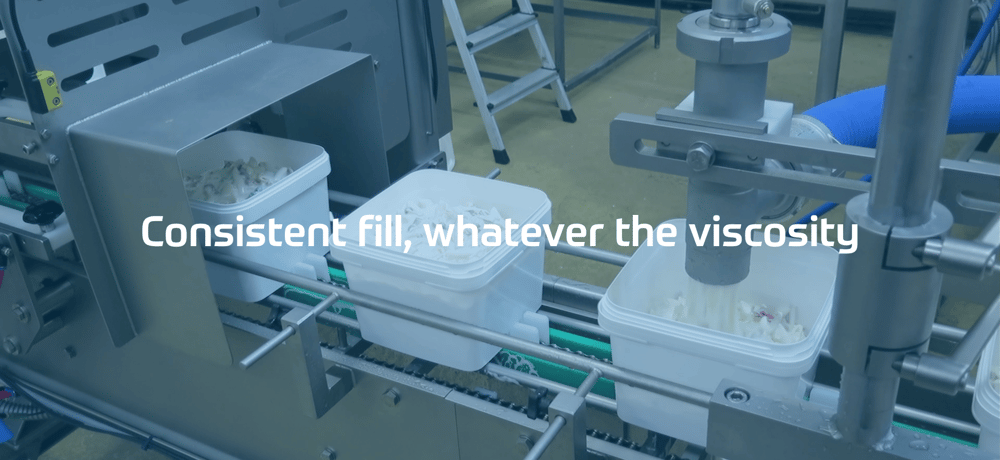
Ready meal sauce viscosity changes constantly during processing because temperature, fat content, starch, and particle size all affect how a sauce flows. Even a few degrees of temperature swing can turn a smooth-flowing sauce into one that under-fills trays, overflows, or leaves inconsistent portion weights. Processors control this by stabilising product temperature, adjusting formulation, and using servo-driven depositing technology — such as Leonhardt's LEO! Depositor — that's designed to handle changing viscosity without sacrificing fill accuracy.

What Is Sauce Viscosity, and Why Does It Change During Ready Meal Production?
Viscosity is simply a measure of how easily a liquid flows. A light tomato sauce flows quickly with little resistance; a thick cheese sauce, mashed potato, or gravy resists flow and needs more force to move through pipework and depositing heads.
In ready meal production, ready meal sauce viscosity is rarely fixed. It shifts continuously through the process, driven by:
- Product temperature — the single biggest variable
- Recipe formulation — fat, starch, and protein levels
- Water content and particle size
- Cooking time and cooling rate
This matters because thermal properties of food are directly tied to flow behaviour. Research on salad sauces found that temperature has a measurable effect on apparent viscosity, with flow behaviour and consistency indices both shifting as products moved between 20°C and 40°C (Álvarez, Cancela and Maceiras, 2007). Fat-containing sauces show the same pattern in reverse: as fat cools and begins to solidify, viscosity climbs sharply enough to make pumping difficult and, in some cases, block equipment lines entirely.
Viscous ready meal products such as sauces, soups, and meat slurries are also inherently harder to cool than thin liquids, because their high viscosity and low thermal conductivity slow heat transfer — a well-documented challenge in chilled and frozen ready meal manufacturing that's often addressed through vacuum cooling rather than conventional methods.

Does Sauce Temperature Affect Depositing Accuracy?
Yes. As sauce temperature changes, viscosity changes with it, and depositing accuracy follows.
- A hot cheese sauce flows smoothly straight off the line, then thickens noticeably after only a short cooling period.
- A tomato-based sauce tends to thin as temperature rises, which can throw off fill weight if the depositor isn't compensating.
- In hot sauce manufacturing specifically, viscosity is shaped by the water-to-solids ratio, the presence of thickening agents, and how finely particulates are ground — too coarse and the texture turns irregular, too fine and the sauce becomes too liquid (Sofraser, 2025).
Maintaining a stable product temperature ahead of the depositor is one of the most effective ways to hold fill accuracy steady across a production run.
Why Viscosity Instability Causes Depositing Problems
When viscosity drifts unexpectedly during a shift, manufacturers typically see:
- Underfilled or overfilled trays
- Product overflow at the nozzle
- Poor weight control and increased giveaway
- Product separation or inconsistent appearance
- Unplanned stoppages and extra cleaning cycles
These issues scale with line speed — the faster the run, the less margin there is to correct for a sauce that's behaving differently than it did an hour earlier.
Viscosity doesn't only shift during active production, either. It's part of the sauce's life cycle. A shelf-stability study on flavoured sauces found that several formulations underwent measurable thinning and viscosity loss after around ten months of ambient storage, alongside ingredient separation, which is a reminder that formulation choices made at the food science stage have consequences long after the tray is sealed (Purohit et al., 2023).
Liquid Handling Challenges: Sauces With Inclusions
Few ready meal depositing systems handle pure liquid alone. Most are managing liquid handling challenges created by:
- Vegetable pieces, chicken chunks, or seafood
- Pasta, rice, or beans
- Meatballs and herbs
Each of these adds mechanical complexity. The depositing system has to move both the sauce and the solid inclusions accurately and in proportion, without crushing delicate pieces or letting particulates settle out of suspension — all while the base sauce's viscosity is itself moving with temperature and hold time.
How Food Science and Sauce Formulation Reduce Viscosity Problems
Good depositing performance is largely decided before production starts, at the food science and sauce formulation stage. Manufacturers formulating for consistent flow typically look at:
- Product temperature control — holding sauce within a stable window from cook to deposit
- Recipe adjustment — small formulation tweaks that improve flow without changing taste or appearance
- Pump and technology selection — matching equipment to the product's viscosity and particulate size
- Gentle handling — protecting delicate inclusions while keeping portion control tight
As one food scientist quoted in a trade feature on sauce formulation put it, a foodservice sauce and a retail ready meal sauce are formulated very differently from the outset, because the end use — jarred, frozen, vacuum-sealed, or shelf-stable — changes what the sauce needs to do at every stage (Prepared Foods, 2014). That distinction is exactly why formulation and depositing technology need to be considered together, not separately.
Choosing the Right Depositing Technology for Variable Viscosity

Modern depositing systems are built to handle a wide range of product consistencies without giving up accuracy or speed. Servo-driven depositing technology in particular offers:
- Greater dosing accuracy across changing viscosities
- Improved repeatability, tray to tray
- Faster recipe changeovers
- Lower energy consumption than pneumatic systems
- Better control over complex, multi-component recipes
- Seamless integration with automated packaging lines
This is especially valuable for manufacturers running multiple ready meal varieties — and multiple sauce viscosities — on a single line.
Leonhardt's LEO!: Built for Variable Ready Meal Viscosity
For manufacturers looking to improve depositing accuracy and production flexibility, Leonhardt's LEO! Depositor has been developed specifically to handle the viscosity range found across modern ready meal production.
LEO! is suitable for a wide range of homogeneous and pumpable products — soups, sauces, dressings, mashed potato, stews, deli salads, puddings, fruit preparations, and ready meal components — combining precise servo-driven dosing with gentle product handling.
Key benefits:
- High-accuracy piston dosing
- Fully servo-driven operation
- Intuitive 10" touchscreen HMI with recipe management
- Quick product changeovers
- Hygienic IP66 design
- Industry 4.0 connectivity
- Compact, mobile construction
- Easy cleaning and maintenance
Its intelligent controls help manufacturers hold fill accuracy steady while adapting quickly to different recipes and viscosity ranges, shift to shift.
Supporting Smarter Ready Meal Production
Consistent depositing comes down to understanding ready meal sauce viscosity — how formulation, temperature, and equipment interact — rather than treating fill accuracy as a settings problem to fix on the line.
At Sealpac UK & Partners, we work with food manufacturers to deliver integrated processing and packaging solutions tailored to their products and production goals. Whether you're exploring new ready meal applications or optimising an existing line, our team can help identify the right depositing technology — including the latest innovations from Leonhardt's LEO! — to support reliable, efficient, and future-ready production.
Contact us today to explore how Sealpac UK & Partners can transform your production line with automation, efficiency, and expert support.

Explore Our Blogs: Stay informed about the latest trends and technologies in food processing and packaging by visiting our blogs.